
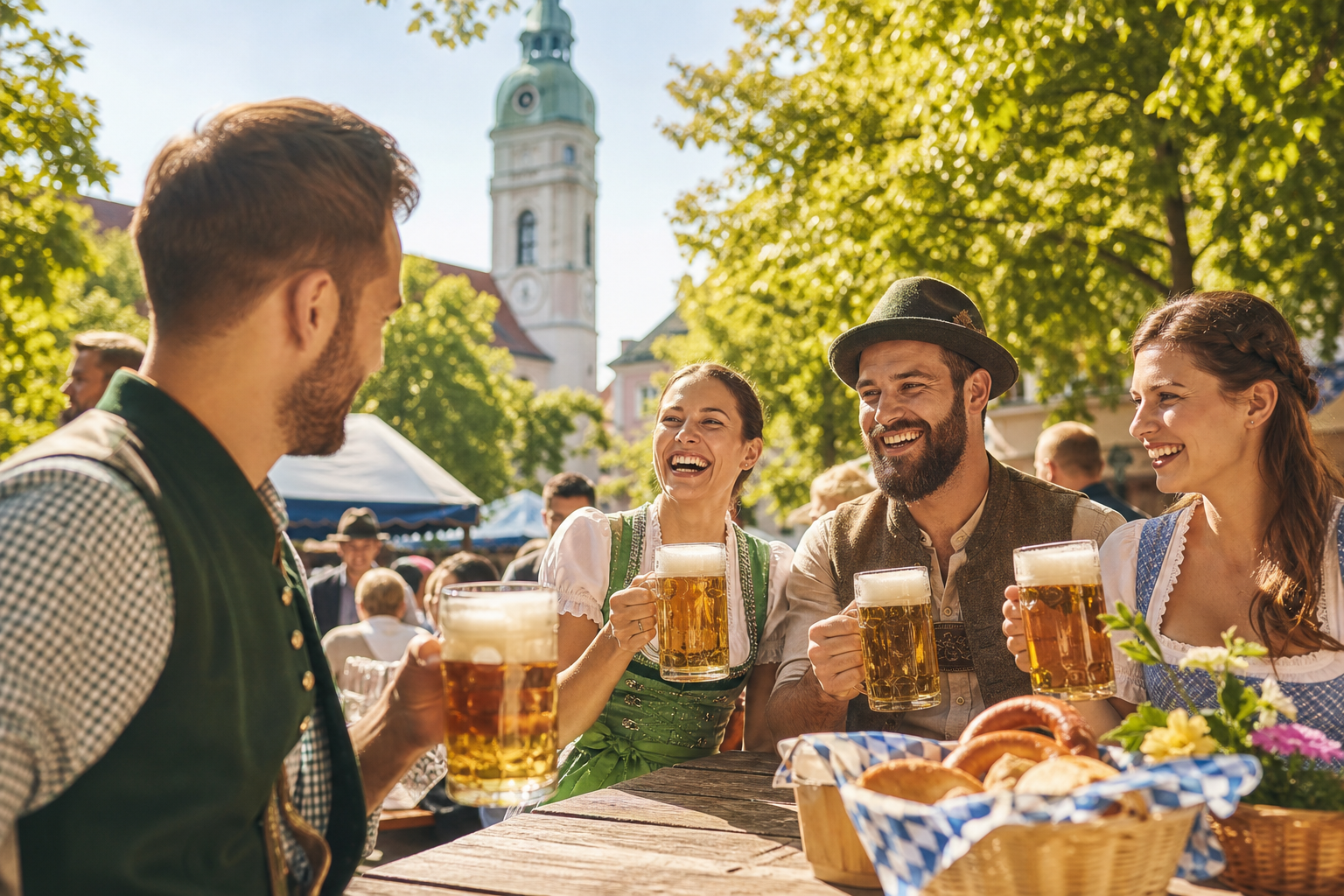

Most travellers know Munich and beer are inseparable, but for many the prospect of Oktoberfest has become less appealing: overcrowded tents, accommodation prices that triple overnight, and an atmosphere that one long-term Munich resident described as having lost its local character entirely. If that sounds familiar, you are not short of alternatives. Bavaria runs a full calendar of beer-focused events from early spring to late autumn, many of which are genuinely worth travelling for in their own right.
This is a focused Munich beer festivals travel guide built for exactly that purpose. Rather than listing every village Volksfest in the region, it gives you a curated shortlist of the best alternatives, explains what each one is actually like to attend, and then helps you work out which suits your travel style and dates. By the end you should be able to pick a specific festival, book around it with confidence, and put together a trip that feels like Munich rather than a theme-park version of it.
Munich Beyond Oktoberfest: The Lesser-Known Beer Festivals Worth Traveling For
The standout alternative beer festivals in and around Munich
Munich and the towns around it keep their beer-garden chairs busy from March through October, and the quality of what you find at smaller venues is often just as high as at Oktoberfest, with noticeably lower prices and far friendlier access to a seat.
Starkbierfest, the Strong Beer Festival held during Lent across most of March, takes place in Munich breweries and most famously on the Nockherberg hill. The whole thing runs indoors, which makes sense given Munich’s cold spring, and the atmosphere is intimate and convivial rather than rowdy. The beers served are strong Lenten doppelbocks, richer and more potent than standard Märzen. One traveller who attended in 2018 noted they had expected only locals and instead found a warm mix of regulars and curious visitors from abroad, all sharing tables in halls with live music that genuinely swings. For beer enthusiasts who want a cosy, deeply Bavarian experience without the tourist crush, this is the standout choice.
Frühlingsfest, the Spring Festival, runs for roughly two weeks at the end of April into early May on the same Theresienwiese grounds as Oktoberfest. Think of it as a scaled-down version of the big event: a handful of large tents, beer gardens, funfair rides and the same brass-band soundtrack, but with noticeably fewer tourists and much easier access to seats. Regulars on the Rick Steves travel forum describe it as the Oktoberfest they actually wanted, and for travellers who want that specific set-up without fighting for space, Munich’s Springfest is a fantastic alternative.
Auer Dult is a traditional fair held three times a year in the Au district at Mariahilfplatz, roughly in May, late July or early August, and October. It is more a Bavarian market fair than a pure beer festival, with stalls selling antiques, ceramics and household goods alongside beer gardens and Bavarian food. The crowd is overwhelmingly local and family-oriented, and the pace is unhurried, making it the right choice for anyone as interested in everyday Munich life as in the beer itself.
Kocherlball at the Chinese Tower in the Englischer Garten takes place on one Sunday morning in July and is unlike anything else in the Munich calendar. The event commemorates a 19th-century tradition of servants and workers gathering to dance before their employers woke up; today, hundreds of people arrive at dawn in Tracht to waltz and polka, followed by breakfast beers in the surrounding beer garden. It is compact, atmospheric and utterly traditional, and it rewards early risers and culture-seekers who want a real memory rather than a Maß count.
Freising Volksfest is what many locals describe as the warm-up for Oktoberfest. Held in late August or early September, roughly 40 minutes from central Munich by regional train, it features one or two tents, a small fairground and a crowd made up almost entirely of local families and groups of friends. The beer is the same high-quality regional lager you get at Oktoberfest, the music is equally good, and the prices are considerably gentler. Staying in Freising itself is cheaper than Munich, and the historic hilltop town is worth a look in daylight.
Similar in character are the Dachau Volksfest and the annual fair at Erding, both reachable from Munich on regional trains and both offering one-tent atmospheres where you will almost certainly end up sharing a bench with local families rather than stag parties. Erding has the added draw of one of Europe’s largest indoor spa complexes if you want to build a fuller day around the visit.
Which Munich beer festival suits your travel style?
The festivals above differ not just in timing but in what they actually feel like, so the easiest way to choose is to be honest about your own priorities.
If you are party-focused and want lively bands, table-dancing later in the evening and a real sense of occasion, Frühlingsfest on a Friday or Saturday evening is your best bet. The larger local Volksfeste in Freising or Dachau deliver a similar energy on weekend nights, and unlike Oktoberfest you will not need to book a tent reservation weeks in advance just to get through the door.
Families and groups wanting a calmer experience should look at daytime sessions at Frühlingsfest, any of the three Auer Dult fairs, or a small-town Volksfest. Children’s rides are common at all of these, the crowds thin out well before late evening, and you can leave long before things get rowdy without feeling you have missed the point.
For travellers who want to live like a local rather than observe from a tourist perch, Starkbierfest in the brewery halls, Kocherlball with its dawn dancing and beer-garden breakfast, and Auer Dult all deliver something genuinely different. These are events where Tracht is worn because people want to wear it, folk music is played because people want to hear it, and the rituals feel earned rather than performed.
Beer enthusiasts chasing something specific will find Starkbierfest the most rewarding, with its strong Lenten doppelbocks brewed by Munich’s own houses. A side trip to Freising, which sits alongside one of Bavaria’s oldest brewery traditions, adds further depth, and smaller Volksfeste also pour excellent regional lager at prices closer to what Munich locals actually pay day to day.
Budget-conscious travellers should note that avoiding Oktoberfest dates brings accommodation costs back down to normal city levels. Beer and food at Frühlingsfest and Starkbierfest are typically a little cheaper than at the main event, and basing yourself in an outlying suburb or a satellite town like Freising cuts costs further while keeping you within easy reach of the action by S-Bahn or regional train.
Munich beer festivals travel guide: planning dates, beds and transport
Planning around these festivals is meaningfully less stressful than organising an Oktoberfest trip, but dates still shift slightly from year to year, so check the official Munich tourism website or the relevant city’s own events calendar before booking flights.
For Frühlingsfest and Starkbierfest, central Munich accommodation in popular areas like Altstadt, Glockenbach and around Hauptbahnhof can fill on weekends, so book three to six months ahead if you want a central base at a reasonable rate. Slightly outlying neighbourhoods on the U-Bahn or S-Bahn lines, such as Schwabing, Neuhausen or Sendling, are easier to find and usually cheaper without adding much travel time.
For the Volksfeste in Freising, Dachau or Erding, you have two practical options: stay in Munich and use the regional train network for day or evening visits, or base yourself in the festival town for a quieter, cheaper stay. These towns are compact enough that the station, festival grounds and accommodation are all within a short walk of each other. A Bayern Ticket covers unlimited travel on regional trains and Munich’s U-Bahn, S-Bahn, trams and buses for a day, making the logistics inexpensive and straightforward. In 2018, one group reported paying 43 euros for four travellers on a Bayern Ticket covering a full day in and around Munich.
Reservations at the bigger Frühlingsfest tents and some Starkbierfest venues are possible for evening sittings, but solo travellers and small groups can often walk in at opening time or on a weekday evening without one. If you are visiting on a Saturday night and have your heart set on a particular tent, it is worth checking whether the venue takes bookings.
For transport within the city, the U-Bahn connects directly to Theresienwiese for Frühlingsfest, while trams and buses serve the Nockherberg area for Starkbierfest, Mariahilfplatz for Auer Dult and the Englischer Garten for Kocherlball. None of these require a taxi or any particular planning beyond checking the MVV network.
Allow at least two nights for a single festival: one main day at the event and another for sightseeing or a quieter session. Three to four nights works better if you are combining two events or adding day trips. On costs, budget for one or two large beers, a hot meal and transport per session, and expect to spend noticeably less overall than you would for the equivalent Oktoberfest day.
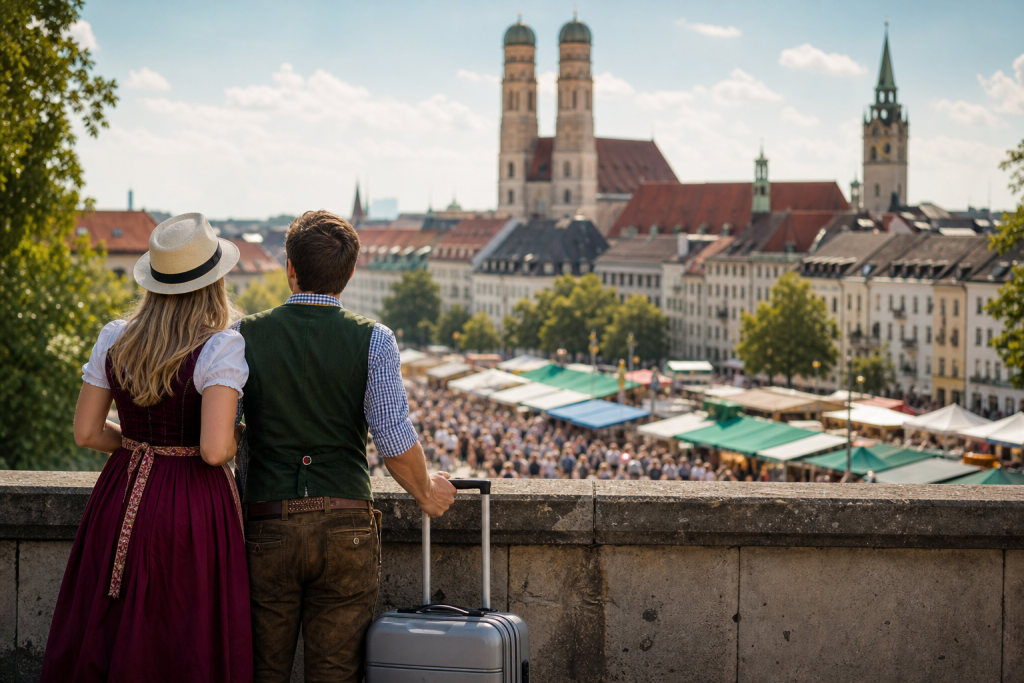
Munich beer festivals travel guide: planning dates, beds and transport
On-the-ground etiquette and survival tips for smaller festivals
These events are more relaxed than Oktoberfest, but Bavarian beer-tent etiquette is consistent across all of them and knowing the basics makes the difference between a smooth evening and an awkward one.
Seating is communal in every tent and most beer gardens, so ask before sliding onto a bench, acknowledge the people already sitting there, and order from the server assigned to your section rather than waving at whoever catches your eye. Beer in tents is typically served in one-litre Maß glasses, though beer gardens and Auer Dult often have smaller measures available. When your drink arrives, it is customary to take a proper first pull rather than nursing it from the start. One regular Munich festival-goer put it simply: pull down about half with your first drink.
Cash is still widely used at food stalls and at smaller Volksfeste, so carry enough euros for the evening. Larger tents in the city, particularly at Frühlingsfest, increasingly accept cards, but smaller outdoor stalls almost universally do not.
Tracht is optional at all of these events, though you will see plenty of Dirndl and Lederhosen at Starkbierfest, Frühlingsfest and especially Kocherlball. Neat casual clothes are completely fine. Closed shoes are sensible in any tent where beer inevitably meets the floor, and layers are wise for cool spring or autumn evenings.
Arriving early matters on busy nights. For popular Friday and Saturday sittings without a reservation, aim to be there at or just after opening time. For Kocherlball specifically, you need to be at the Chinese Tower around dawn if you want to see the dancing rather than the aftermath.
Before the evening gets going, check your last tram or S-Bahn time, because festival nights pass quickly. Stick to well-lit routes back to stations, and use official taxi ranks or licensed ride services if you are staying out late. Weekday evenings and afternoon sessions at any of these events are noticeably calmer than Saturday nights if you prefer to avoid large, rowdy crowds.
Staff across Munich’s venues speak enough English to take an order and answer a simple question, but a few words of German and a willingness to engage warmly go a long way. Sharing tables and chatting with the people around you is, after all, the whole point.
Turn your chosen festival into a full Munich and Bavaria itinerary
The smartest way to use any of these festivals is as the anchor around which you build the rest of the trip. Fix the festival dates first, then layer in city days and one or two day trips, leaving enough flexibility for weather and energy levels.
If Starkbierfest is your anchor, evenings in the brewery halls pair naturally with daytime visits to the Deutsches Museum, long walks along the Isar river and the classic beer halls of the Altstadt. Cool March weather makes this one of the better months for indoor culture; the city’s museums feel unhurried in a way they rarely do in summer, and a short brewery tour in Munich or in nearby Freising fits the theme well.
Frühlingsfest pairs well with springtime mornings in the Englischer Garten and an afternoon at Nymphenburg Palace and its park, which are at their best when the cherry trees are out. A day trip to Neuschwanstein, Salzburg or the Bavarian Alps is straightforward on regional trains and takes less than two hours from the city.
Auer Dult and Kocherlball lend themselves to a slower pace of Munich exploration: the Au-Giesing neighbourhood around the Dult fairground, the Viktualienmarkt for breakfast provisions, the Residenz and the city’s Baroque churches. If you are up for Kocherlball at dawn, a relaxed afternoon in a beer garden afterwards is the natural recovery.
For a trip built around Freising, Dachau or Erding, a simple pattern works well: spend a day in Munich, take the regional train to the festival town in the afternoon, attend the Volksfest in the evening, and use the following morning to look around before returning. Dachau’s historic centre and memorial site warrant a serious visit in their own right, and Freising’s hilltop cathedral district is one of the more overlooked spots in the Munich day-trip radius. Erding combines pleasantly with a few hours at its Therme spa complex.
With one well-chosen festival and a handful of nearby experiences arranged around it, you will leave Munich having seen more of how the city and its region actually work, at a fraction of the Oktoberfest cost, and almost certainly with better memories of the people you shared a bench with.